


Page 27 - Craftcil Feb 2024
P. 27
seminars


           detection and capability development among others. He  Sharma has more than two decades of industry experience having
           highlighted success stories on career engineering and sustainable  worked in sectors like, Packaging, Textile, Retail, Telecom,
           business growth- cultural transformation, customer centric  Executive Education and Trainings. He has an MBA in Marketing
           output. Mr. Sharma concluded with a slide on energy efficiency  and HR. He has been associated with CII for more than a decade,
           with a mention of EPCH’s initiative taken with CII about  looking after industry capability development and
           Competitive Nest Acceleration support for EPCH members. Mr.  competitiveness enhancement initiatives.


                      Crafting a Circular Future: Navigating Sustainability and Carbon Impact

           • Circular Economy Concept and Circular Economy Models  • Carbon Impacts on Eco  system
           • Evaluation criteria for Environmental, Social, and Governance (ESG)
           • Carbon Border Adjustment Mechanism (CBAM)


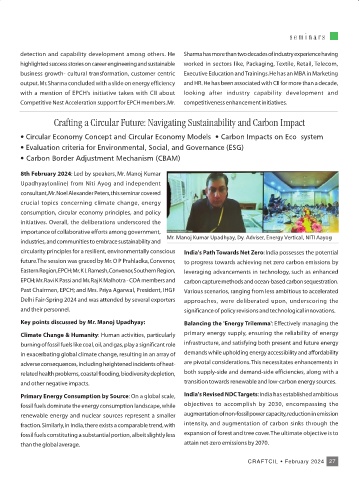
           8th February 2024: Led by speakers, Mr. Manoj Kumar
           Upadhyay(online) from Niti Ayog and independent
           consultant, Mr. Noel Alexander Peters, this seminar covered
           crucial topics concerning climate change, energy
           consumption, circular economy principles, and policy
           initiatives. Overall, the deliberations underscored the
           importance of collaborative efforts among government,
                                                            Mr. Manoj Kumar Upadhyay, Dy. Adviser, Energy Vertical, NITI Aayog
           industries, and communities to embrace sustainability and
           circularity principles for a resilient, environmentally conscious  India's Path Towards Net Zero: India possesses the potential
           future.The session was graced by Mr. O P Prahladka, Convenor,  to progress towards achieving net zero carbon emissions by
           Eastern Region, EPCH; Mr. K L Ramesh, Convenor, Southern Region,  leveraging advancements in technology, such as enhanced
           EPCH; Mr. Ravi K Passi and Mr. Raj K Malhotra - COA members and  carbon capture methods and ocean-based carbon sequestration.
           Past Chairmen, EPCH; and Mrs. Priya Agarwal, President, IHGF  Various scenarios, ranging from less ambitious to accelerated
           Delhi Fair-Spring 2024 and was attended by several exporters  approaches, were deliberated upon, underscoring the
           and their personnel.                                   significance of policy revisions and technological innovations.
           Key points discussed by Mr. Manoj Upadhyay:            Balancing the 'Energy Trilemma': Effectively managing the

           Climate Change & Humanity: Human activities, particularly  primary energy supply, ensuring the reliability of energy
           burning of fossil fuels like coal, oil, and gas, play a significant role  infrastructure, and satisfying both present and future energy
           in exacerbating global climate change, resulting in an array of  demands while upholding energy accessibility and affordability
           adverse consequences, including heightened incidents of heat-  are pivotal considerations. This necessitates enhancements in
           related health problems, coastal flooding, biodiversity depletion,  both supply-side and demand-side efficiencies, along with a
           and other negative impacts.                            transition towards renewable and low-carbon energy sources.

           Primary Energy Consumption by Source: On a global scale,  India's Revised NDC Targets: India has established ambitious
           fossil fuels dominate the energy consumption landscape, while  objectives to accomplish by 2030, encompassing the
           renewable energy and nuclear sources represent a smaller  augmentation of non-fossil power capacity, reduction in emission
           fraction. Similarly, in India, there exists a comparable trend, with  intensity, and augmentation of carbon sinks through the
           fossil fuels constituting a substantial portion, albeit slightly less  expansion of forest and tree cover. The ultimate objective is to
           than the global average.                               attain net-zero emissions by 2070.

                                                                                       CRAFTCIL • February 2024   27

