


Page 28 - Craftcil Feb 2024
P. 28
feature - 57th IHGF Delhi Fair - Spring 2024


           Key Policies and Initiatives: Numerous governmental
           endeavors, including the National Solar Mission, Circular Economy
           in Textiles, and the Ekta Mall Initiative, are geared towards fostering
           sustainability and circular economies. Additionally, the RAMP
           scheme endeavors to assist MSMEs in the adoption of eco-friendly
           practices while addressing payment-related challenges.

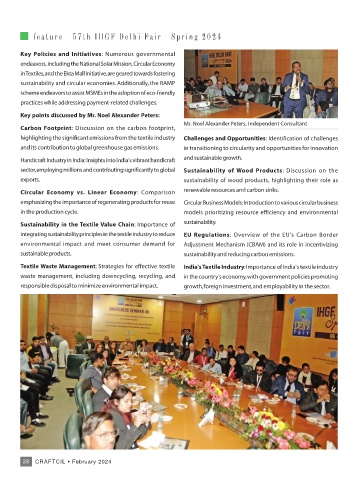
           Key points discussed by Mr. Noel Alexander Peters:
                                                                 Mr. Noel Alexander Peters, Independent Consultant
           Carbon Footprint: Discussion on the carbon footprint,
           highlighting the significant emissions from the textile industry  Challenges and Opportunities: Identification of challenges
           and its contribution to global greenhouse gas emissions.  in transitioning to circularity and opportunities for innovation
                                                                 and sustainable growth.
           Handicraft Industry in India: Insights into India's vibrant handicraft
           sector, employing millions and contributing significantly to global  Sustainability of  Wood Products: Discussion on the
           exports.                                              sustainability of wood products, highlighting their role as
                                                                 renewable resources and carbon sinks.
           Circular Economy vs. Linear Economy: Comparison
           emphasizing the importance of regenerating products for reuse  Circular Business Models: Introduction to various circular business
           in the production cycle.                              models prioritizing resource efficiency and environmental

                                                                 sustainability.
           Sustainability in the Textile Value Chain: Importance of
           integrating sustainability principles in the textile industry to reduce  EU Regulations: Overview of the EU's Carbon Border
           environmental impact and meet consumer demand for     Adjustment Mechanism (CBAM) and its role in incentivizing
           sustainable products.                                 sustainability and reducing carbon emissions.

           Textile Waste Management: Strategies for effective textile  India's Textile Industry: Importance of India's textile industry
           waste management, including downcycling, recycling, and  in the country's economy, with government policies promoting
           responsible disposal to minimize environmental impact.  growth, foreign investment, and employability in the sector.


            28  CRAFTCIL • February 2024

